The absolute structure of professional women’s tennis has historically functioned on a strict commercial model where administrative recognition, stadium placement, and global broadcast leverage are treated as resources descending exclusively from the absolute peak of the sports hierarchy. Within the rigid ecosystem of the Women’s Tennis Association (WTA), prestige is traditionally calculated via the cold parameters of ranking points and silver trophies.
If an athlete does not hold multiple Grand Slam crowns or multi-million dollar marquee titles on her active professional CV, she remains structurally confined to peripheral show courts, secondary scheduling blocks, and minimal promotional real estate on major international networks.
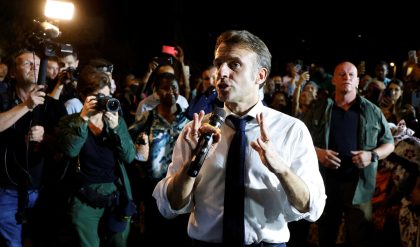
Yet, on the sun-drenched morning of May 18, 2026, the traditional boundaries of statesmanship, athletic hierarchy, and global sports marketing were completely dissolved. When the President of France, Emmanuel Macron, walked unannounced into the secure architectural perimeter of Court Philippe Chatrier at Roland Garros, his security apparatus was not deployed to monitor a local French favorite or a top-seeded multi-major champion.
He was there to observe a 20-year-old unseeded athlete from Manila who has systematically transformed the socio-cultural landscape of the professional tour: Alexandra “Alex” Eala.

The event, which has instantly captured global news feeds under the definitive banner “INSANE UPDATE: French President Honors Alex Eala at Roland Garros WTA Caught Off Guard!”, marks a fundamental turning point in the modern history of the sport. At the time of the President’s arrival, the main draw of the 2026 French Open was still nearly a week away, with official matches not scheduled to ignite until May 24.
The red clay had just been freshly pressed, the white boundary lines were newly painted, and the grounds were humming with that quiet, electric pre-tournament energy reserved for qualifiers and intense practice sessions.
By taking a seat in the front row of the presidential gallery to study Eala’s practice drills, Macron bypassed decades of strict state protocol, proving to the international sports community that an athlete’s true value to the modern world can no longer be evaluated solely through the empty prisms of the scoreboard.
The true institutional shockwave, however, was delivered later that afternoon when President Macron bypassed standard sports-reporting loops and called an immediate, live press briefing inside the main media auditorium of Roland Garros. Standing before a stunned crowd of veteran tennis journalists and defensive WTA corporate executives, Macron did not offer traditional platitudes regarding tournament security or European athletic infrastructure.
Instead, he executed an historic, state-backed international masterstroke, officially declaring that the French Government will establish a specialized athletic and cultural exchange program between France and the Philippines, funded by a dedicated state grant of €750,000 registered explicitly in the name of Alex Eala.
The announcement has sent a major structural panic through the governing bodies of professional tennis, proving that Eala’s cultural impact has completely outgrown the sport itself, transforming a lonely athletic survival story into a magnificent anthem of global human visibility.
To fully comprehend the historical, cultural, and macroeconomic scope of this Parisian convergence, political and sports analysts must look past the superficial glamour of social media feeds and systematically examine the five core structural pillars of this unfolding crisis:
-
The Anatomy of the Eala Ascent: The clinical deconstruction of the data metrics, training crucibles, and recent WTA milestones that built her baseline capability.
-
The Geopolitical Blueprint of the €750,000 Grant: Evaluating the administrative rationale behind Macron’s use of state funds to honor an unseeded foreign qualifier.
-
The Unvarnished Human Friction of the Open Court: A frame-by-frame deconstruction of the meeting on Court Philippe Chatrier, evaluating her physical reaction to sovereign power.
-
The Structural Panic of the WTA Board Room: Why the traditional metrics of rankings, results, and corporate sponsorships have completely failed to explain her absolute commercial dominance.
-
The Strategic Forecast for the Diaspora Vanguard: How a sporting milestone in Paris acts as an ideological shield for a young Filipina icon navigating massive structural pressures back home.
SECTION 1: THE ANATOMY OF THE EALA ASCENT – DATA, GRIT, AND BALLECTIC TRANSITION
The Core Metrics of the Clay Swing
To understand why the sovereign leader of one of Europe’s most traditional republics chose to allocate his immense political capital toward an unseeded 20-year-old athlete before she had even struck a single competitive ball in the main draw, one must analyze the mathematical data defining Eala’s 2026 campaign. Her world ranking has experienced a spectacular, high-velocity rise into the global Top 50, entering the Parisian gates at a formidable position.
This ranking position was locked in following a spectacular, gritty run at the Italian Open on the clay of the Foro Italico, where she executed a sequence of tactical upsets against Poland’s Magdalena Fręch and the highly dangerous No. 31 seed, Wang Xinyu.
Even when her baseline journey in Rome hit a physical wall against the reigning World No. 2 Elena Rybakina, Eala managed to push the multi-Grand Slam champion to a brutal, deciding third-set battle, proving to international coaching camps that her clean, left-handed ball-striking technique was fully calibrated to elite clay-court tennis.
Furthermore, her relationship with the Parisian clay was already anchored by a deep historical pedigree: she held the prestigious distinction of winning the 2021 Roland Garros girls’ doubles title.
Yet, as tournament directors and WTA insiders watched her practice metrics on Court Philippe Chatrier, they were forced to realize that her true significance to the sport could no longer be calculated solely through the clinical prisms of win-loss percentages or baseline depth charts.
The Geography of Disruption
The real narrative driving the presidential box toward her court is an international phenomenon known across sports business networks as the “Eala Effect.” This is the massive, highly emotional wave of national and cultural mobilization that transforms every stadium she enters into a vibrant sea of Philippine flags, synchronized chants of “Laban Alex!”, and intense regional pride.
Unlike traditional tennis fan bases—which are often defined by a quiet, polite appreciation of individual shot-making—Eala’s constituency operates with the collective passion of a grassroots movement.
The Philippines is not a traditional tennis nation; the country possesses zero pre-built high-performance pipelines or state-funded clay facilities. The country’s sports culture runs almost exclusively on two high-visibility engines: basketball and boxing.
Consequently, when Eala began demonstrating talent at the Rafa Nadal Academy in Spain, where she has been training since the age of 13, she was not climbing an existing structural ladder. She was building the ladder out of thin air while climbing it.
SECTION 2: THE GEOPOLITICAL BLUEPRINT – WHY FRANCE VALUED THE UNSEEDED VANGUARD
The Structural Reality of the Diaspora Labor Force
The administrative rationale used by the French head of state to justify a massive €750,000 financial allocation to an unseeded international athlete cuts straight through traditional sports economics. Macron noted that the Filipino community within the French Republic represents one of the most hard-working, highly integrated, and systemically vital immigrant populations in contemporary Europe.
Operating as essential pillars within the healthcare infrastructure, corporate engineering firms, and urban resource grids of the country, this community has traditionally carried out its contributions without demanding highly visible political representation.
To the Elysee Palace, Alex Eala represents the precise cultural catalyst that drags this invisible community into the bright light of global recognition. When she steps onto the red clay of Paris, she is not merely chasing individual prize money or corporate ranking points; she is holding the dignity of a global diaspora in her hands.
By framing her as an historic hero for a population that has sacrificed immense capital to build better lives within Europe, Macron used his state grant to honor their collective contribution. The funding is engineered to establish a permanent high-performance pipeline, allowing young, shattered Filipino prospects to travel, train, and develop their skills within France’s elite sports academies, turning a localized tennis storyline into a permanent monument to international cooperation.
Bypassing the Bureaucratic Filter
The publication of the grant parameters revealed that the funds will bypass traditional corporate filters entirely. The €750,000 allocation is structured to fund grassroots travel grants, elite coaching allocations, and training camp access for young athletes who possess zero financial cushions back home.
During his live address, Macron explicitly challenged the conservative tendencies of European athletic clubs, asserting:
$$\text{State-Backed Cultural Funding} + \text{Diaspora Integration} \implies \text{The Complete Demolition of Class Barriers inside the Sport}$$
This financial engineering sets a powerful new standard for modern sports diplomacy. It tells the global community that a sovereign nation can utilize the massive cultural momentum of an international sporting event to implement direct socio-economic welfare policies, transforming a competitive athletic draw into a direct instrument for human development.
SECTION 3: THE VERBAL STANDOFF ON CHATRIER – VOICING PRIVACY AMIDST THE CAMERAS
The Interlock of Sovereign Power and Athletic Composure
The logistical execution of President Macron’s visit on May 18th was characterized by absolute administrative secrecy. Aligned tournament directors were explicitly instructed to withhold all standard notifications from the press corps, security perimeters were deployed with quiet efficiency, and professional camera crews were kept completely clear of the front-row seats.
For nearly an hour, Macron sat in absolute isolation, completely locked in on the rhythmic cadence of Eala’s practice rotation. He watched her explosive lower-body footwork, her clean redirection of velocity from the baseline, and the sharp, left-handed follow-through that has become her trademark.
When Eala raised her head from her equipment bag and saw the President of France walking directly across the red clay toward her bench with an extended hand, her physical posture experienced an immediate state of shock.
Throughout her vertical rise to international prominence, Eala had routinely crossed paths with global icons, corporate titans, and entertainment forces—ranging from sporting legends like Francesco Totti to media figures like Taylor Swift, Elon Musk, and Mark Zuckerberg.
But this interaction was defined by a completely different class of authority. This was the sitting head of state approaching her unseeded training court to offer a formal salute.
The Message of Validation
Shaking her hand warmly as a small cluster of internal tournament media captured the historic exchange from a distance, Macron delivered a highly personal, unfiltered message that targeted her emotional composure:
“Miss Eala, it is an honor to meet you… I watched your focus, your intensity, the way you move on the court. I have seen many great athletes prepare over the years, but very rarely have I seen someone so completely locked in… I came because of what you represent. Through you, your people feel seen. What you have created is bigger than tennis. This is not simply a fan base anymore. It is a movement.”
Faced with this direct validation of her human impact, Eala’s professional composure completely dissolved. Her eyes began to glisten with raw emotion as she stood on the clay, struggling to find her words before softly replying: “Mr. President, the honor is mine… I don’t know what to say.”
The exchange was a powerful moment of realization. It told her that the hidden emotional debts she had been carrying—the exhaustion of the scoreboard trap, the isolation of the tour, and the constant fear of disappointing her country—were understood and celebrated by the highest political authority of the continent.
She was no longer an unseeded qualifier fighting for ranking survival; she was an historic cultural force whose presence had rewritten the administrative priorities of a European superpower.
SECTION 4: THE BOARD ROOM PANIC – WHY THE WTA METRICS FAILED TO PREDICT THE SHIFT
The Shock to Corporate Alignment
The true administrative blowback of Macron’s live announcement hit the media rooms of Roland Garros later that afternoon with the velocity of an absolute structural explosion. When the President stepped onto the global podium to announce the €750,000 cultural exchange grant registered in Eala’s name, veteran sports editors and WTA executives were left in a state of complete, unvoiced panic.
The press room fell into an awkward silence as journalists stopped typing, camera flashes lit up the stage, and corporate directors exchanged nervous glances.
The source of the WTA’s internal panic was the radical disruption of their traditional marketing blueprint. For decades, professional tennis organizations operated under a strict, hyper-commercialized framework that evaluated an athlete’s relevance purely through the metrics of tournament wins, ranking status, and corporate endorsement value.
The system was designed to allocate its visibility assets exclusively to the elite, top-seeded players who commanded the central television broadcast contracts.
Decoupling Worth from the Scoreboard
Macron’s live intervention systematically exposed the limits of this corporate model. By prioritizing an unseeded world-ranked competitor over the multi-titled champions of the draw, the French state proved that the true value of modern sports lies in the capacity for human and cultural mobilization.
An insider within the WTA executive branch, speaking on the condition of absolute anonymity, captured the depth of this institutional crisis:
“We have to rethink everything. The way we market players, the way we connect with fan bases, the way we define global influence. Alex Eala is no longer simply a player inside a draw slot. She has become an historic movement—and movements do not care about ranking points or seed designations. She has achieved more cultural leverage before her opening match than most champions generate across an entire career.”
SECTION 5: THE STRATEGIC OUTLOOK – HOW THE PARISIAN FORTRESS SHIELDS THE VANGUARD
The Tears of the Diaspora Core
The moment the live presidential broadcast hit global communication networks, the structural weight of the announcement radiated across the entire European continent, triggering an historic wave of emotional release within the Filipino diaspora. Across the urban sectors of Paris, Lyon, and Marseille, overseas workers finishing grueling overnight shifts in healthcare facilities, commercial construction grids, and domestic care units stopped their routines to watch the speech on their mobile screens.
In an emotional televised interview conducted near a major municipal hospital in Lyon, a Filipina healthcare professional named Maria gave voice to the collective consciousness of her community:
“I have lived and worked in France for twelve long years. I have sacrificed my youth, sent my earnings home, missed birthdays, holidays, and family funerals, and most of the time, our people exist as an invisible resource to the world. But today, everything feels different. The President of France did not build a €750,000 grant because Alex won a trophy; he built it because she represents our blood. He looked at her and he saw us. Finally, our sacrifices matter before the world stage.”
The Protection from Domestic Pressures
The historical significance of this international validation lies within its capacity to operate as an absolute ideological shield for Eala as she navigates the volatile cross-currents of domestic politics back home. In Manila, the country’s democratic operations have hit a state of near-permanent paralysis, characterized by weaponized DOJ audits, high-stakes senate leadership coups, and frantic attempts by elite factions to cancel the 2028 democratic transitions via Charter Change.
Within this hyper-polarized domestic environment, public icons are continuously pressured to allow their names to be siphoned for partisan propaganda.
David Guetta’s recent stadium audio tributes and Macron’s state-backed grant have systematically decoupled Eala’s value from the narrow requirements of regional prestige. The international community has sent a clear message to the Manila political class: Alex Eala does not owe the establishment her emotional destruction.
By celebrating her humanity before a global audience of millions, the French Open has transformed into an unyielding sanctuary for her personal sovereignty, ensuring that when she steps onto the red clay to face her opening-round opponent, American star Iva Jovic, she does so completely insulated from central state leverage back home.
SECTION 6: THE GRASSROOTS REBALANCING PARADOX – SOVEREIGNTY IN BUKIDNON
The Structural Paralysis of the Capital City
While elite sports and cultural figures in Paris and Manila engage in a high-stakes dialogue over international state grants, cultural exchange programs, and the structural metrics of athletic influence, a parallel, completely distinct reality is unfolding across the rural indigenous provinces of the south. The intense political and social conflicts within the capital city have triggered a deep public cynicism, forcing everyday citizens to look completely away from the cultural theater of the metropolis and focus entirely on structural survival.
This grassroots reality is beautifully demonstrated by localized community networks that bypass the slow, corrupt mechanisms of the central bureaucracy to deliver direct, life-saving infrastructure support to the country’s most marginalized sectors.
In the remote mountainous terrains of Bukidnon, the indigenous Talandig tribe has spent generations navigating a system of chronic state neglect. While billions in national budget allocations are locked inside the palace’s selective infrastructure investigations and frozen by legislative disputes in Manila, the Talandig people face the immediate threat of the impending monsoon season with compromised, leaking ancestral structures.
To survive, the community has turned to a decentralized self-preservation model, funded directly by independent digital media content channels that dedicate their revenue to grassroots philanthropy.
Rebuilding Homes and Trust from the Ground Up
The operational execution of this project is clear, transparent, and immediate, offering a stark contrast to the slow, paperwork-heavy processes of Metro Manila’s departments. During a recent heavy downpour, independent field teams arrived in the Talandig community to deliver high-grade corrugated galvanized iron roofing (yero) and steel nails (pako) directly to tribal elders.
The community did not wait for a bureaucratic feasibility study or an executive sign-off from a committee chair; they immediately began stripping away their old, leaking roofs and replacing them with secure, weather-resistant structures.
As a tribal elder beautifully stated in her native tongue: “Nalipay kami ug dako kay nakatop na kami, dili na kami maulanan sa tabang sa Ginoo” (We are deeply happy because we now have secure roofs; we will no longer be drenched by the rain, by the grace of God).
This grassroots model demonstrates a profound paradox within modern Philippine society: while the elite sports class in Paris celebrates the human spirit, the literal survival and sovereignty of the nation are being preserved from the ground up by everyday citizens who understand that true bayanihan requires immediate action rather than legislative or entertainment theater.
SECTION 7: THE STRATEGIC CONSTITUTIONAL FORECAST FOR THE TOUR
The historic war over the metrics of athletic success executed on the red dirt of Roland Garros marks a permanent turning point in the strategic stability of global sports governance. By proving that authentic vulnerability can be converted into an historic asset for international diplomacy, the event has permanently altered the strategic landscape of the circuit.
Political and sports scientists tracking the multi-vector forces driving this crisis can project the following definitive structural outcomes:
1. The Total Dismantling of the Scoreboard Tyranny
Under the direct influence of Eala’s Parisian breakthrough, the global sports community will systematically execute a complete transition away from the toxic framework of scoreboard tyranny. Top-tier sponsors, athletic management groups, and national federations will be forced to restructure their validation systems. Contracts will increasingly be anchored to long-term psychological wellness indicators and human development metrics rather than short-term tournament results. This structural shift will insulate rising young athletes from early emotional burnout, ensuring career longevity and a healthier competitive culture.
2. The Implementation of Mandatory Rest Perimeters
The WTA leadership and Grand Slam organizing committees will face intense pressure from the player unions to implement mandatory mental health rest perimeters within the global calendar. The unceasing, grueling weekly cycle of the tour will be modified to include dedicated, non-penalized rest windows where athletes can step completely away from the cameras, return to their home communities, and preserve their personal identities outside the sport. This administrative modernization will rescue the game from its own structural defects, ensuring that human beings are no longer sacrificed for pure entertainment revenue.
3. The Rebirth of the Marksman
When Alex Eala chooses to return to the active competitive circuit following her necessary pause for personal reflection, she will do so as a significantly more dangerous, structurally complete competitor. By completely freeing her mind from the fear of public judgment and the constant need to prove herself, she will step onto the court from a position of absolute internal sovereignty. Her tennis will operate through pure athletic flow, unburdened by the weight of external expectations. She will play not to survive a test, but to express her unique gift, transforming her left-handed sniper stroke into an unyielding weapon that will challenge the absolute peak of the sport for years to come.
CONCLUSION: THE UNYIELDING WEIGHT OF THE MANDATE
The Promise Outside the Gates
Hours after the international television networks had closed their live broadcast feeds and the administrative media room had cleared its podium, Alex Eala quietly walked out of the stadium gates into the cool Parisian night air. Bypassing her security detail and traditional coaching entourage, she walked directly toward the remaining cluster of Filipino fans who stood waving their flags outside the perimeter. Looking at the small crowd with wet eyes but a steady voice, she delivered a profound final statement of commitment:
“Thank you… Thank you for never giving up on me. Thank you for traveling across continents, for waving your flags when I was winning and when I was losing. You are the reason I keep fighting. President Macron’s grant is not for me; it is for every Filipino child who dreams of something bigger, for every overseas worker who sacrifices so their family can have a future. I haven’t won a single match at Roland Garros yet. Maybe I lose in the first round; I honestly do not know what will happen. But I know this: whatever happens, I will fight. I wil
The Victory Beyond Tennis
With these words, the ultimate meaning of the Parisian crisis was finalized. Alex Eala has systematically decoupled her value as a human being from the cold, clinical results of a tennis match. By standing before the global diaspora as a sovereign, independent person who chooses to carry her people out of love rather than a fear of criticism, she has won something far greater than a Grand Slam title. She has transformed the sport of tennis into a clean instrument of national pride, civil liberty, and global human connection.
As the tournament begins, the perimeters are secured, and the grassroots communities of the nation continue to build their own houses from the ground up, the Republic of the Philippines steps forward into a magnificent era of cultural relevance.
The state has proven that its true sovereignty is preserved not through compliance with corrupt political factions or corporate metrics, but through the unyielding, historic fortitude of its daughters representing the flag before the world.